
- In Breath Healing Health Uncategorised Walk/Run
- Tagged with back pain, sore knees, squats
How to Make Squats More Accessible When You Have Back Pain, Knee Issues, or Limited Mobility
Squats are one of the most important functional movements we use throughout life. They help us rise from a chair, lift ourselves from the ground, climb stairs, and walk uphill with greater confidence.
But conventional deep squats are not always accessible. If you are managing a sore back, damaged or sensitive knees, restricted mobility, or simply feel intimidated by full-depth squats, it can be difficult to know where to begin.
The good news is that you do not need to force yourself into the same squat position you see young, highly mobile people performing online. A gentler, breath-led approach can help you practise the movement within a comfortable range.
Why Squatting Matters for Everyday Life
Squatting is more than a gym exercise. It is a movement pattern that supports many day-to-day activities, including:
- Standing up from a chair or toilet
- Picking something up from a low surface
- Getting in and out of a car
- Walking up stairs or hills
- Maintaining lower-body strength and independence as you age
The Challenge With Traditional Squats
This approach uses your hands and breathing rhythm as guides. The aim is not to chase depth. It is to build a controlled, repeatable squat pattern that respects your current ability.
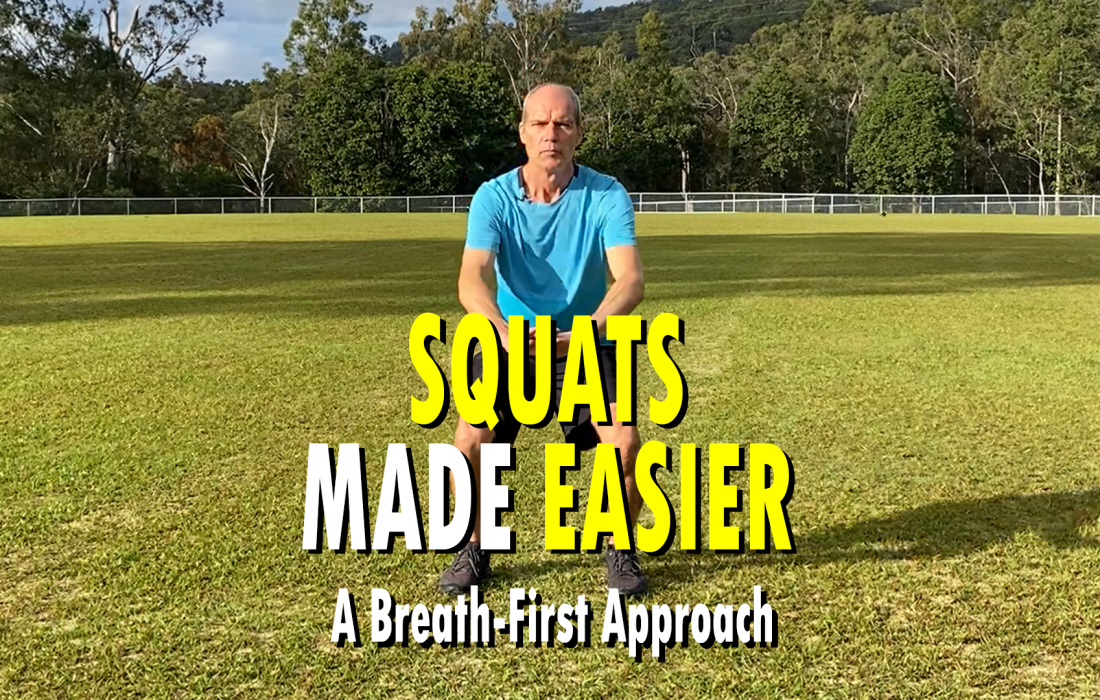
Step 1: Set Up Your Stance
Stand with your feet positioned comfortably and facing forward. Aim for a stable, grounded stance rather than forcing your feet into an uncomfortable position.
Keep your posture tall:
- Gently tuck your chin in.
- Lengthen upward from the back of your skull.
- Draw your shoulders up, back, and down.
- Keep your torso organised and supported as you move.
Step 2: Use Your Hands as a Depth Guide
Bring your hands together by gently wrapping your thumbs, creating a simple reference point in front of your body.
As you begin to lower into the squat, follow the movement of your hands. Your hands become a practical limit: do not lower farther than you can maintain comfortably while staying connected to your breath and posture.
Step 3: Slow the Knee Movement Down
Rather than allowing the knees to rush forward or drop quickly, move slowly and deliberately. Let your body descend only as far as you can control.
The goal is not to force range of motion. It is to gradually teach your body that the movement can be safe, calm, and steady.
Step 4: Follow the 3-STEP Breathing Rhythm
Let Your Mobility Improve Gradually
With regular practice, you may find that your knees and hips gradually allow you to move lower with greater comfort. However, depth should always be earned—not forced.
Stay Within Your Current Limits
Only squat as far as you can while maintaining:
Let Your Mobility Improve Gradually
With regular practice, you may find that your knees and hips gradually allow you to move lower with greater comfort. However, depth should always be earned—not forced.
Stay Within Your Current Limits
Only squat as far as you can while maintaining:
- A steady, comfortable breath
- Upright, organised posture
- Controlled knee movement
- A stable foot position
- No sharp or worsening pain
Your hands and breath connection are your boundaries. If you lose either one, reduce the range of motion.
Prioritise Posture Over Depth
A shallow squat with good control can be more useful than a deep squat performed with collapsed posture, strained knees, or held breath.
Keep your chin gently tucked, lengthen through the back of the head, and maintain the shoulders in a relaxed but supported position. These small details can help you stay more connected to your whole body throughout the movement.
Build Squat Confidence for Life
Squatting does not need to look impressive to be valuable. It needs to be functional, controlled, and appropriate for your body.
By using a simple hand guide, slowing the movement down, and connecting your squat to a steady breathing rhythm, you can begin practising this essential movement in a more accessible way.
A Note on Pain and Injury
If you have a diagnosed knee or back injury, persistent pain, numbness, weakness, or balance concerns, consult a health professional before starting or progressing an exercise routine. A physiotherapist or exercise professional may be able to help tailor the movement to your individual needs.
Learn More About Breath Rhythms
Specific breathing rhythms like the TriBreath breath rhythms can be integrated into many everyday movements—not just squatting. The 3-STEP rhythm can also be implemented when you walk, run, push, push, peddle, even paddle.
For a deeper introduction to breath rhythms and ways to bring them into daily life, consider downloading the TriBreath Move Easier Breathe Deeper ebook.
Because now is a good time to connect.
Brett Hayes
TriBreath™ Coach
BECOME A TRIBREATH™ MEMBER TODAY

100% MONEY BACK GUARANTEE:
This is my guarantee to you. If within 30 days of your TriBreath™ Membership registration, if you can honestly say you put the effort in to time your body up to your breath, and you don’t feel more connected and more in control of your breath and your body, if you ask for a refund, it will be given!
MOVE EASIER, BREATHE DEEPER, WALK TALLER, RUN FASTER
Inside the TriBreath™ Members Teaching Area, there you’ll find an ever updated library of video’s to help…
- Strengthen your breath, mind and body connection.
- Age friendly techniques to increase and restore your lung capacity.
- Lose weight as you focus on your oxygen intake using the TriBreath™ movements for a low-impact full body workout anywhere, anytime.
- Enjoy the freedom to exercise, elongate and strengthen your core when you’re out walking.
- Discover injury and rehabilitation techniques to help keep you active and mobile.
- Increase neural activation to help restore, maintain and regenerate body communication.
- Downloadable PDF’s and so much more!